By Linda Mujuru
Government officials, miners, and development partners gathered in Harare this week to discuss how Zimbabwe can transition toward mercury-free gold mining, in a sector long known for its environmental and health challenges.
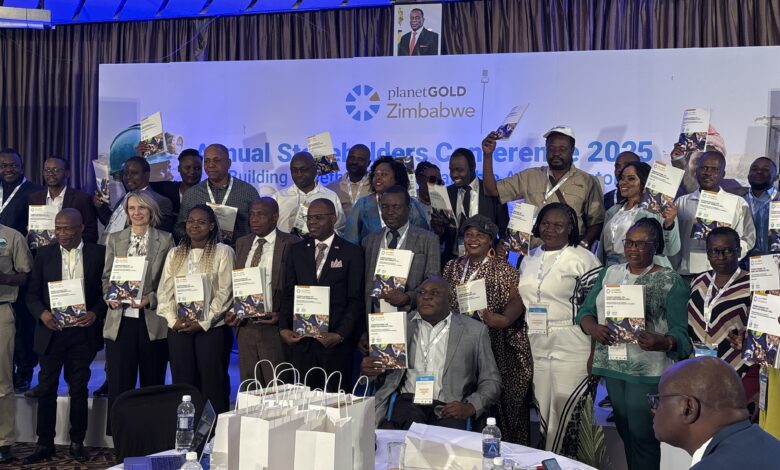
The meeting, held at the Monomutapa Crowne Plaza from October 27 to 28, brought together stakeholders under the banner of the planetGOLD Zimbabwe Annual Stakeholders Conference. The event focused on finding practical ways to formalise artisanal and small-scale gold mining (ASGM) a vital source of income for thousands of Zimbabweans while reducing its harmful impacts.
Supported by the Global Environment Facility and led by the UN Environment Programme (UNEP), the planetGOLD Zimbabwe project will been running for five years with an ambitious goal: to help 7,500 miners across several sites reduce mercury use by nearly five tonnes and to improve land management on 76,000 hectares. The project is implemented by IMPACT in collaboration with the Ministries of Mines, and Environment, Climate and Wildlife.
In opening remarks, officials from both ministries acknowledged that small-scale mining remains one of the country’s most dynamic but least regulated sectors. Abraham Matiza from the Ministry of Environment, Climate and Wildlife said sustainable development in mining depends on finding a balance between livelihoods and environmental protection.
“We are not just talking about gold. We are talking about people’s health and the survival of communities that depend on this sector,” Matiza said.
Matiza added that over the past year, the government has reviewed the National Action Plan on Mercury to align it with emerging global priorities and domestic realities as the country prepares for COP-6 of the Minamata convention this November.
Chief Engineer Michael Munodawafa from the Ministry of Mines said ongoing reforms to the Mines and Minerals Bill aim to make mining more transparent and inclusive, giving artisanal miners better access to formal markets and safer working conditions.
The conference featured a range of discussions on policy, finance and technology. Participants examined ways to build trust between large-scale and artisanal miners, expand access to credit, and replace mercury-based practices with cleaner technologies.
One of the key moments was the launch of a new publication, Strengthening the Mines and Minerals Bill: Advancing Reforms for the Benefit of Artisanal and Small-Scale Gold Miners in Zimbabwe. The document outlines recommendations for making the law more responsive to the needs of small miners, particularly women and youth who often work on the margins of the formal economy.
Representatives from the Environmental Management Agency (EMA), Médecins Sans Frontières (MSF), and the Zimbabwe Miners Federation (ZMF) shared perspectives on health and environmental risks linked to mercury. They noted that despite awareness campaigns, many miners continue to rely on mercury because of limited access to alternatives and the cost of modern processing equipment.
Mercury use in artisanal mining is a leading source of global pollution, responsible for severe health problems in mining communities. In Zimbabwe, the chemical is still widely used to extract gold, often in open pans and riverbeds, where it contaminates water and soil.
Nyaradzo Mutonhori, the project manager for planetGOLD Zimbabwe, said the initiative has made progress in building awareness and demonstrating that responsible mining is possible. “This conference is not just about reporting results,” she said. “It’s about building partnerships that can outlast the project and make responsible mining the norm, not the exception,” she said.