Women Farmers Turning the Tide Against Climate Change in Shurugwi
By Ngonidzashe David Dhoro
As she sings a melodious hymn from her church book, a middle-aged woman spreads piles of homemade fertiliser across her tomato seedbeds in the remote rural community of Matimba in Shurugwi.
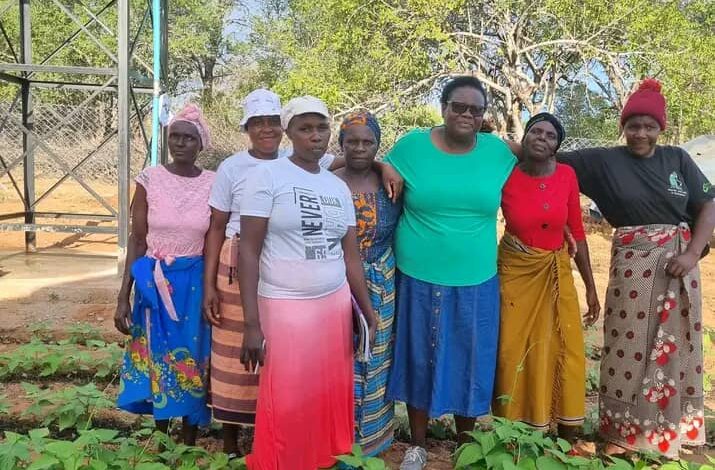
For Joyce Zivuku (40), a passionate farmer and mother of three with strong Christian values, the establishment of an irrigation scheme in her community by Women and Land in Zimbabwe (WLZ), a non-governmental organisation working with rural communities to eliminate gender discrimination in land access while empowering marginalised women with sustainable livelihoods, has greatly improved her life.
“We had lost hope in farming, but when WLZ came to our community, we were taught sustainable farming practices like growing cash crops and making natural fertilisers,” said Zivuku.
WLZ is a member-based association working to empower rural women across 25 districts in eight provinces in Zimbabwe, particularly through climate change adaptation initiatives such as irrigation schemes. The organisation focuses on improving women’s access to land, knowledge, and agricultural resources, which have historically been limited in many rural communities.
The scheme provides women with the tools, training, and infrastructure needed to move from subsistence farming to cash-crop production. It offers a sustainable solution to erratic rainfall, prolonged droughts, and rising temperatures that continue to threaten traditional rain-fed agriculture.
According to climate expert and Director of the Meteorological Department, Rebeca Manzou, smallholder farmers in Zimbabwe depend largely on seasonal rainfall, making them highly vulnerable to climate variability. In recent years, the country has experienced frequent droughts linked to the global climate phenomenon El Niño, reducing crop yields and intensifying food insecurity in rural areas.
Before the establishment of the scheme, Zivuku worked as an illegal artisanal miner, earning too little to support her family. Like many rural residents, she had turned to informal mining after repeated crop failures caused by drought.
Through the WLZ initiative, she now grows cash crops such as cabbage, green pepper, beans, butternuts, onions, and cucumbers. She is one of 36 women benefiting from the scheme in her community.
“Through these crops, I earn about US$700 per harvest. Before, I was just a subsistence farmer,” she said.
Women play a crucial role in Zimbabwe’s agricultural sector. According to a 2024 report by the Green Climate Fund, women constitute approximately 70 percent of the agricultural workforce in the country. Despite this, many lack access to extension services, farming inputs, and climate-adaptation training.
Systemic barriers such as limited access to land ownership, capital, and farming equipment continue to hinder women farmers’ full potential. In many rural communities, customary laws favour male ownership, leaving women dependent on family or communal arrangements for land.
In an interview, WLZ Gender and Advocacy Officer Gloria Makahwi said beneficiaries of the irrigation schemes have improved their livelihoods through training in sustainable farming.
“They have acquired skills in agro-ecological farming practices, meaning they can farm without using chemicals,” she said.
“In these schemes, they have also set up greenhouses, and some beneficiaries are replicating what they learn at the scheme in their own homes.”
Agro-ecological farming is environmentally friendly, as it reduces the use of chemical fertilisers and pesticides while improving soil fertility organically.
Another beneficiary, Beauty Fambi, shares Zivuku’s experience.
“Before I joined the initiative, I was farming, but I lacked adequate knowledge and my yields were low,” she said.
“I learned how to grow tomatoes, prune bottom leaves, and use homemade fertilisers such as bokashi, fish fertiliser, and mixtures made from cow dung and urine.”
She now understands the difference between open-field farming and greenhouse farming, where crops are protected from harsh weather conditions.
Her yields have doubled in recent years, and she is now training other women in her community using the skills she gained through WLZ.
With a radiant smile, Fambi describes how the programme has transformed her life and those of other women.
“This programme started in 2017, and that is when we began our garden. WLZ trained us and helped build good relations with our local headman,” she said.
“No one had ever taught us farming, yet we thought we knew. After the training, I now know how to plant, nurture tomatoes, prune leaves, and use homemade manure.”
Across Zimbabwe, climate-resilient agriculture programmes introduced by government agencies, development organisations, and farmer unions are helping strengthen rural livelihoods. These include conservation farming, solar-powered irrigation, and community seed banks.
Founder and National Coordinator of the Women in Agriculture Union (WAU), Olga Nhari, says empowering women in agriculture is key to both gender equality and national food security.
“Rural women are increasingly vulnerable to climate change. Women, children, and the elderly are taking on a large share of agricultural labour and household food security responsibilities,” Nhari said.
She added that financial systems, laws, and reforms must be adapted to support women farmers.
“Establishing inclusive financial models tailored to women’s realities, strengthening women’s land ownership rights, and investing in off-grid technologies such as solar-powered irrigation and cold storage can go a long way,” she said.
Despite these challenges, women in the community now see themselves as businesswomen, able to support their families and sustain their livelihoods.
“I am very grateful and thank God that I am part of Women and Land Zimbabwe. It has changed my life. I encourage other women to join and learn how to fend for themselves,” said Zivuku.