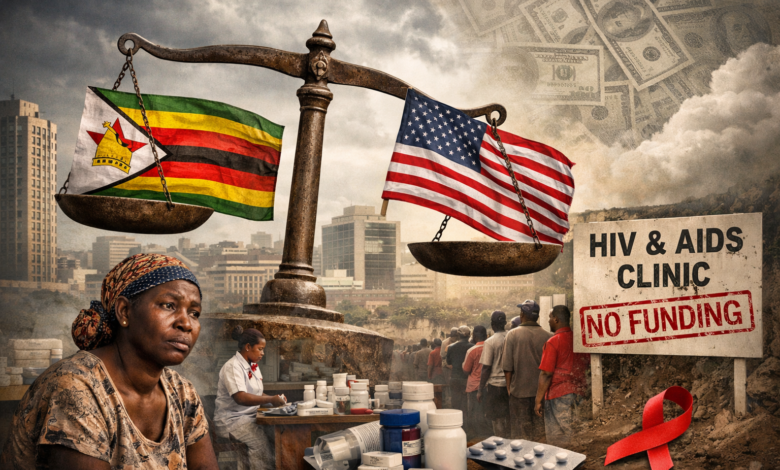
Zimbabwe Weighs Sovereignty and Sustainability in Shifting HIV Funding Landscape
By Staff Reporter
Zimbabwe’s HIV response has long been regarded as one of Southern Africa’s public health success stories. Once among the countries hardest hit by the epidemic, Zimbabwe achieved the UNAIDS 95-95-95 targets: 95 percent of people living with HIV know their status, 95 percent of those diagnosed are on antiretroviral therapy (ART), and 95 percent of those on treatment have achieved viral suppression. Reaching these benchmarks placed Zimbabwe among a small group of countries considered on track to end AIDS as a public health threat.
That progress now faces renewed scrutiny after the United States announced it will wind down its health assistance to Zimbabwe following the government’s withdrawal from negotiations on a proposed $367 million, five-year health Memorandum of Understanding (MOU).
According to the U.S. Embassy in Harare, the proposed agreement would have supported priority programmes including HIV and AIDS treatment and prevention, tuberculosis, malaria, maternal and child health, and disease outbreak preparedness. The embassy said the funds were intended to benefit approximately 1.2 million Zimbabweans receiving HIV treatment through U.S.-supported programmes.
Since 2006, the United States has provided more than $1.9 billion in health assistance to Zimbabwe, largely through PEPFAR, supporting HIV treatment, laboratory systems, medicine procurement, and community-based services. U.S. assistance has been central to Zimbabwe’s attainment of the 95-95-95 targets.
However, government spokesperson Nick Mangwana, in a statement, said the proposed agreement raised concerns about sovereignty.
“The proposed agreement offered substantial health funding reported to be in the region of US$328 million in exchange for comprehensive access to Zimbabwe’s sensitive health data, including pathogen samples and epidemiological information from our citizens. While the offer of assistance was acknowledged, the structure of the agreement raised profound concerns regarding sovereignty and fairness,” he said.
Mangwana added that Zimbabwe was being asked to share biological resources and data without guarantees of access to resulting medical innovations such as vaccines, diagnostics, or treatments.
Several African countries, including Malawi and Mozambique, have signed similar bilateral health agreements with the United States under the new co-investment framework, committing to increasing domestic health financing alongside continued U.S. support. Zimbabwe is among the first countries to publicly withdraw from negotiations under the model, with neighbouring Zambia also doing the same.
Zimbabwe’s HIV burden remains significant. Approximately 1.3 million people are living with HIV, according to national data. Sustaining treatment for such a large population requires reliable drug supplies, functioning clinics, trained health workers, and consistent laboratory monitoring. Even short disruptions can increase risks of treatment interruption and drug resistance.
Recent data presented to Parliament show AIDS-related deaths in the first half of 2025 rose to 5,932 compared to 5,712 during the same period in 2024. While multiple factors influence mortality trends, the figures have heightened concern about the fragility of recent gains.
Zimbabwe has not relied solely on donors. The country introduced the AIDS Levy in 1999, a dedicated income tax that funds HIV programmes through the National AIDS Council. While the levy and government allocations contribute significantly, development partners have continued to finance a substantial share of HIV services, including medicines and service delivery.
In 2024, PEPFAR and the Global Fund committed hundreds of millions of dollars to Zimbabwe’s HIV response. Yet national planning documents acknowledge persistent financing gaps, meaning reduced external assistance would place additional strain on domestic systems.
Gaps also remain among specific populations. While national targets have been met, treatment coverage for children and adolescents lags behind that of adults, requiring sustained outreach and paediatric formulations.
U.S. Secretary of State Marco Rubio, outlining the America First global health strategy, said, “Our global health foreign assistance program is not just aid, it is a strategic mechanism to further our bilateral interests around the world. Moving forward, we will utilise our health foreign assistance to advance U.S. priorities and move countries towards resilient and durable local health systems.”
He added that the U.S. would leverage foreign assistance to promote American companies and innovations abroad.
For people living with HIV, the funding debate is not abstract; it is personal.
Angela Jambo, an HIV activist since the early 2000s who is also living with HIV, says she has directly benefited from donor-supported programmes.
“Back then, I worked as a cross-border trader. In countries like Botswana and South Africa, people had access to free medication, but in Zimbabwe, those services were not available,” she says.
Over the years, she says donor funding has supported not only treatment but the livelihoods of those with HIV.
“These programs included livelihood support for people living with HIV and assistance for children orphaned by HIV. When USAID funding was stopped last year, there was panic. Many people rushed to clinics to collect several months’ supply of medication because they were afraid it would run out.”
She says clinics later reassured patients that supplies were stable.
“We get our medication on time,” she says.
Still, she worries about what could happen if funding gaps widen.
“At some point we were placed on the government’s social welfare list with the promise that we would receive assistance as people living with HIV, but to this day nothing has come.”
“So when donor funding isn’t there and the government rejects funding from outside, an obvious gap is left. Donors used to come directly to us and provide support. Now we are worried. There are no donors to assist us, and we are not sure whether the government will be able to carry the burden on its own,” she adds.