From Silence to Strength: Zimbabwe Domestic Violence Survivor Empowers Women to Break Free

From Silence to Strength: Zimbabwe Domestic Violence Survivor Empowers Women to Break Free
By Tawanda Bepura
For years, Nokuvimba Matipano lived behind closed doors with the fear and pain of domestic violence. To neighbours, she was simply another woman carrying on with everyday life. But inside her home, she was trapped in a reality shaped by intimidation, humiliation and abuse.
“I kept quiet for a long time because I was afraid,” she said.
Today, she speaks openly not only about what she survived but also about the women she is now helping to find safety and confidence.
Domestic violence remains one of Zimbabwe’s most persistent but underreported social problems. Recent national and international data show violence against women remains widespread. The United Nations Population Fund says about 1 in 3 women aged 15-49 in Zimbabwe have experienced physical violence, while about 1 in 4 have experienced sexual violence since age 15.
The World Bank reported in 2024 that 39.4% of women in Zimbabwe have been subjected to physical violence, while 11.6% have faced sexual violence, underscoring the scale of gender-based violence nationally.
Athanasius Sagonda, a human rights lawyer, says underreporting continues to obscure the full extent of the crisis.
“Many women only seek help when the abuse has become severe,” he says. “By then, they may already have suffered for years.”
For Matipano, the turning point came when she realised silence was placing her life at risk.
“I reached a point where I said enough is enough,” she says. “I had to choose between fear and freedom.”
With support from trusted community members and counselling services, Matipano left the abusive environment and began rebuilding her life. But instead of disappearing into private recovery, she chose to use her experience to help others.
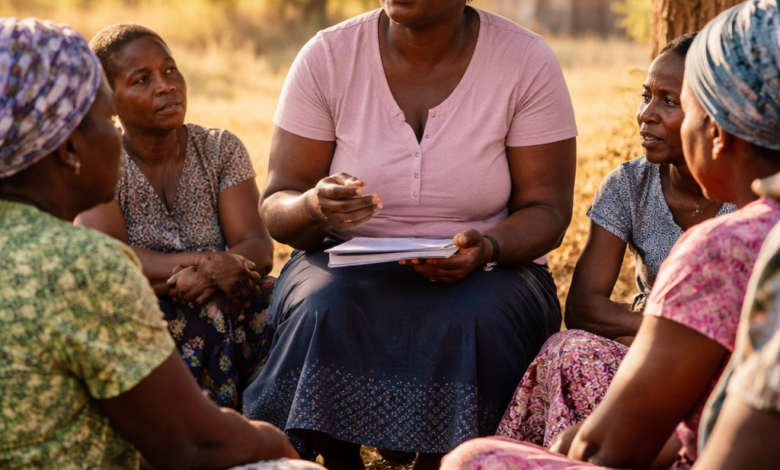
She started a small community support initiative for women affected by domestic violence. Meetings are informal, sometimes held under a tree, sometimes in a borrowed room, but for many women, they offer something powerful: a safe place to speak without judgment.
“We give them a space to talk. Speaking is the first step to healing,” she said.
Women who attend share experiences, receive peer support, learn about counselling options and discuss ways to become financially independent. Some are referred to organisations that provide legal assistance or shelter. Others come to listen until they are ready to speak.
Sharon Matingwina, programmes officer at Musasa Project, a leading Zimbabwean organisation that provides shelter, counselling, legal support and advocacy for survivors of gender-based violence, says survivor-led community spaces can play an important role.
“Many women trust someone who has walked the same road,” she says. “That lived experience can encourage others to seek help earlier.”
Musasa Project has long advocated for stronger protection systems, counselling services and shelters for women fleeing abuse.
Local community leader Simon Dube says attitudes are slowly changing.
“Most women used to suffer in silence because they felt they had no options,” he says. “Now, when they see someone like Matipano standing strong, they begin to believe change is possible.”
Another resident, Rebecca Chikore, says more women are beginning to open up.
“When one woman speaks, others gain courage,” she says. “We are seeing that now.”
Legal advocacy groups such as the Zimbabwe Women Lawyers Association continue to assist women seeking protection orders, maintenance and legal remedies. However, advocates say law reform alone cannot solve the problem.
The United Nations Population Fund Zimbabwe says economic dependence remains one of the major barriers preventing many women from leaving abusive relationships. The agency notes that survivors often stay in violent homes because they lack independent income, safe accommodation or reliable family support, making escape difficult and, in some cases, seemingly impossible
Matipano’s initiative goes beyond emotional support. She also encourages women to pursue income-generating activities such as small-scale trading, poultry projects, sewing and crafts.
“I do not want them to go back because they have no money,” she says.
As the afternoon sun lowers, a small group of women gathers in the community. They talk, laugh, sometimes cry, but they are no longer alone. At the centre of the circle sits Matipano, not as a victim, but as a voice of survival and hope.
Her journey from silence to strength is helping others imagine a life beyond fear.