
Lake Chivero Pollution Crisis: How a Dying Lake Is Devastating Local Businesses and Livelihoods

Lake Chivero Pollution Crisis: How a Dying Lake Is Devastating Local Businesses and Livelihoods
By Staff Reporter
At first light, Kamba Caravan Park, one of the modest tourism spots on Lake Chivero’s shoreline, once woke to the sound of boat engines, anglers unpacking their rods and the smell of frying fish. Today, visitors who come to watch the sunrise over Harare’s largest reservoir find long mats of water hyacinth, slime along the shore and a green sheen that curls over the surface like paint. The customers are fewer. The fishermen are fewer still, but the poachers are many. And the small businesses that depended on the lake’s rhythms, from boat operators to tackle shops, say their livelihoods are unravelling.
Apt and Valerie Olivier, who have owned the park for the past four years, said water pollution, compounded by noise pollution from makeshift nightclubs along the lake, has hit their business hard, as well as that of many other operators around the shoreline.
“The park has been operating for 55 years; the pollution is terrible, and it has affected us badly. Very few people are coming out because they can’t boat or fish as they used to,” said Apt.
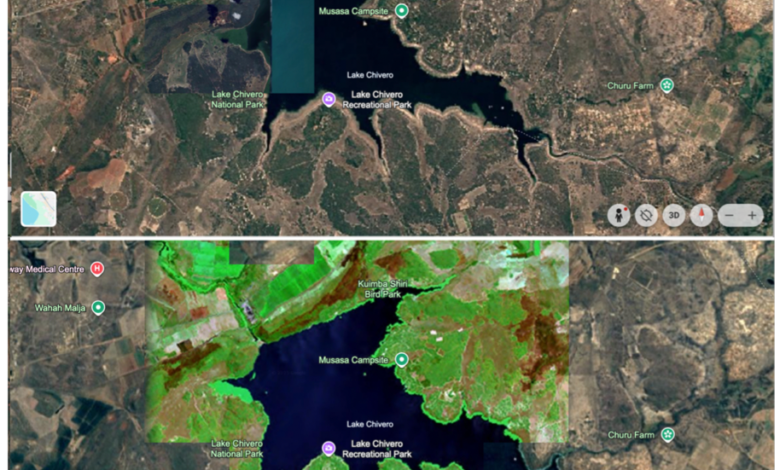
Lake Chivero, built in the 1950s to supply water to Harare and surrounding towns, supported a thriving recreational and small-scale fishing economy for decades. Over the past thirty years, however, a well-documented process of eutrophication, the enrichment of the lake with nutrients such as phosphorus and nitrogen, has turned a source of life into a fragile, toxic system. Numerous scientific studies and remote-sensing analyses show rising nutrient concentrations and recurring, dense cyanobacterial (blue-green algae) blooms. These blooms produce cyanotoxins and deplete oxygen, killing fish and fouling the water used by households and businesses.
The source of the nutrients is no mystery. Lake Chivero sits at the receiving end of Harare’s urban drainage network. Rivers and streams flowing through densely populated suburbs carry raw or poorly treated sewage, industrial effluent and stormwater runoff, all rich in human waste, detergents, fertilisers and other contaminants, into tributaries, then the Manyame River and ultimately Chivero.
The Harare City Council (HCC), responsible for providing and managing essential municipal services such as water supply, wastewater treatment, sanitation, waste collection, roads and local infrastructure, has also been discharging untreated sewage into the lake.
Since 2021, the Environmental Management Agency (EMA) has repeatedly ordered HCC to stop polluting Lake Chivero, even filing a High Court application in June 2025 to compel repairs to the city’s deteriorating water and sewer systems. Despite these orders, HCC continues to discharge an estimated 40–50 megalitres of raw sewage into the lake daily, while Chitungwiza contributes additional effluent. The resulting contamination has turned Lake Chivero into an environmental disaster zone, triggering toxic algal blooms, mass fish deaths and even the poisoning of rhinos at the nearby wildlife sanctuary.
These ecological changes are cascading into economic harm. Local studies show the lake has already lost significant storage capacity and value as a recreation hub; one estimate suggests a roughly 20% loss in storage, with tourism, angling and agriculture linked to the lake all in decline.
Small-scale fishers, many operating informal wooden boats, report shrinking or unpredictable catches. The commercial fishery, once a reliable supplier to Harare markets, has faced repeated shocks from fish kills and contamination fears. For boat operators and parks such as Kuimba Shiri Bird Park, managed by Gary Stafford, fewer anglers and persistent health concerns mean empty calendars and shrinking revenue.
Apt says they have made several complaints and reported illegal and polluting activities, but little has been done. “Most of the time we end up trying to find solutions on our own,” he said.
Amid Lake Chivero’s worsening pollution crisis, however, a growing grassroots movement is attempting to pull the lake back from the brink. At the centre is environmental activist Jean-bertrand Mhandu, who has helped mobilise nearly 700 volunteers and remove more than 35 tonnes of waste through the Chivero Eco Revival Campaign.
“We realised no one was coming to save this lake unless we showed up first,” he said, reflecting on why he began organising large-scale clean-ups of the shoreline, wetlands and bushland.
Working with partners such as ZimParks, EMA, HCC, BirdLife Zimbabwe and several youth groups, the campaign has cleared discarded nets, plastics, bottles and invasive weeds while documenting pollution hotspots. “Every clean-up teaches us something about what’s choking Chivero, so we collect data, not just trash,” Mhandu explained. The initiative has also launched a network of “Chivero Champions,” young community leaders who run monthly mini-clean-ups to maintain momentum between large operations.
Recent efforts, including World Cleanup Day and a major coordinated operation in October, have demonstrated the campaign’s growing reach. “When more than 400 people turn up with gloves and bags, you feel the community saying: this lake matters,” he said.


