Zimbabwe Falling Short on Key Human Rights Commitments, New Report Finds
By Staff Reporter
HARARE – Zimbabwe continues to fall short of its international human rights commitments, with millions of citizens facing challenges in accessing basic services and freedoms, according to new data released by the Human Rights Measurement Initiative (HRMI).
The findings, published in HRMI’s 2026 Rights Tracker dataset, paint a troubling picture of the country’s performance across a range of economic, social, civil, and political rights.
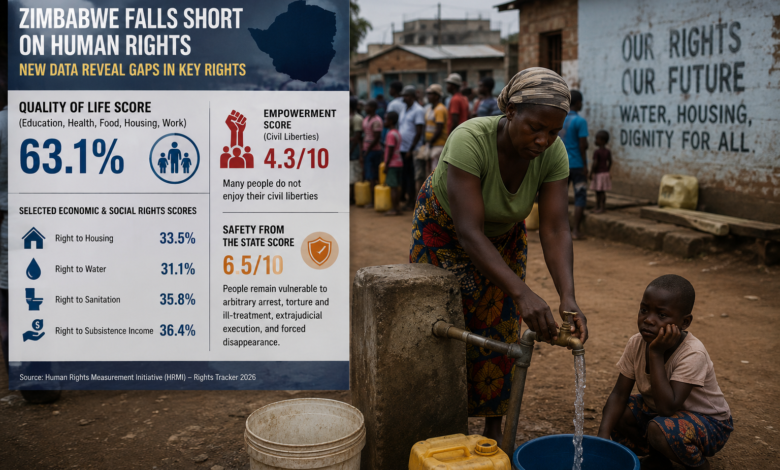
Zimbabwe scored 63.1 percent on HRMI’s Quality of Life Index, which measures the fulfilment of rights related to education, health, food, housing, and work. The score indicates that while some progress has been made, the country remains far from fully meeting its human rights obligations.
Particularly concerning is Zimbabwe’s score on the right to housing, which stood at just 33.5 percent, reflecting what HRMI described as persistent barriers to economic inclusion and access to adequate shelter.
The report identified children and women from low-income backgrounds as among the groups most vulnerable to violations of economic and social rights.
Access to essential services also remains a major challenge. Zimbabwe recorded extremely low scores for the rights to water (31.1 percent), sanitation (35.8 percent), and subsistence income (36.4 percent). According to HRMI, these indicators have been declining over the past 15 years.
“The rights we measure are absolutely fundamental, and leaders must prioritise them,” said Thalia Kehoe Rowden, HRMI’s Co-Executive Director.
“We urge Zimbabwe’s leaders to take action and improve quality of life in light of this data.”
The report also highlights concerns over civil and political rights. Zimbabwe scored 4.3 out of 10 on HRMI’s Empowerment Index, which assesses rights including freedom of assembly and association, freedom of expression, participation in government, and freedom of religion and belief.
According to human rights experts consulted by HRMI, people perceived to oppose the government, human rights defenders, and journalists are among those most at risk of violations of these rights.
Zimbabwe’s overall score for Safety from the State was 6.5 out of 10. This measure evaluates protection from arbitrary arrest, torture and ill-treatment, extrajudicial killings, and enforced disappearances.
The findings come at a time when Zimbabwe is engaged in ongoing political debates, including discussions around constitutional amendments and governance reforms.
Nkosi Sibanda, HRMI’s East and Southern Africa Engagement Lead, said the data show a need for greater focus on improving citizens’ living conditions.
“While considerable national attention and resources are being channelled towards political questions and constitutional amendments, millions of people continue to struggle with access to the basic services and opportunities that underpin human dignity,” said Sibanda.
“The continued decline in rights linked to water, sanitation, housing, and subsistence income suggests that greater priority must be placed on building institutions and public services that work for all Zimbabweans.”
The Human Rights Measurement Initiative is an independent non-profit organisation that produces global human rights data using peer-reviewed methodologies. Its Rights Tracker project measures countries’ performance on a range of civil, political, economic, and social rights.
HRMI says its data are widely used by organisations including Amnesty International, the World Bank, and the United Nations to monitor and assess human rights conditions around the world.